The Guerrilla Girls

Who are they? 

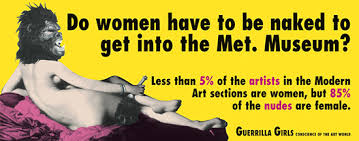
In the spring of 1985 in New York City,  seven women founded the Guerrilla Girls in protest to one of the Modern Museum of Art’s exhibitions. The exhibitions purpose was to showcase the works of the most important artists of that era, out of 156 artists incorporated only 13 of them were female and the number of coloured artists was even slimmer. This is when the Guerrilla Girls were born, their mission was and still is, to bring awareness to gender and racial inequality in the art world.

In a subversive manner, they confront issues through creating posters, billboards, books and doing public appearances. The women choose to stay anonymous by wearing gorilla masks in public settings and also because they do not believe that knowing their identity has any importance. Nowadays, the Guerrilla Girls have expanded due to gaining recognition and having an outpour of support from people and institutions around the globe.

Why you should you know them? 

The Guerrilla Girls speak out on similar topics that I have talked about in my blogs, they have a huge part of why these issues are talked about today. In my opinion, they have been a main source in bringing consciousness to society about the corruption in the art industry, especially when it comes to gender and racial discrimination. 

Their projects are factual due to their unique strategy of collecting data and they incorporate that knowledge into their riveting and playful artworks used for campaigns and exhibitions. This technique engages the public and promotes them to take action and to take part in making a difference.

Additionally, they’ve been given a platform to educate younger and older generations by doing presentations at universities, colleges, museums and art institutions. During these presentations they usually have large audiences and they talk about their evolvement, play music, show slides, watch videos and so on. Having an interactive aspect such as this opens up room for questions and discussions that help people gain a better understanding of the certain injustices in the arts.

Why did I choose to speak to you guys about them? 

My blogs have concentrated on the different issues in arts and design, some of which focused on female inequality in the industry and link to the issues the Guerrillas Girls confront as well. Now that my blog posts are coming to an end I wanted to introduce you guys to a group that can further educate you on the topics I have talked about. If you’re interested in learning more the link to the Guerrilla Girls website is below.

https://www.guerrillagirls.com/#open

So long… 

Caitlin W. 

Why is art so important?

Today I want to speak about the importance of art

Let’s jump right into it, art acts as a way of documentation, which highlights key events in our history while also depicting past ways of life, culture, religion etc. This allows us to have knowledge about human bygone days while also showcasing our evolvement over the centuries.

Now in the present, many artists create work that reflect or challenge current issues that are happening in society such as: politics, ethics, law and so on. This is key for society because in ways artists are able to peacefully protest and bring awareness to problems or situations through their own medium and style. It then constructs a creative way for our communities to be educated and engages younger generations to be a part of a change and to gain comprehension on such subjects.

We should feel incredibly grateful for this because in the past, artists didn’t have the same liberty due to social norms. Although this is unfortunate, these artists have paved a road that has led artists of today into having freedom to create what they want. 

Think of art as being an alternative educational tool rather than just utilizing textbooks as a way to teach. Yes, textbooks do teach us a lot but they usually come from one point of view while shutting out other perspectives. Art on the other hand, gives you the beneficial experience of being able to read and view things from different angles which then enables your mind into coming up with your own opinions and questions that will help you gain consciousness in a way that a textbook may not.

This is why I personally believe that art has a huge importance today. For my whole life I have been a visual learner and art has assisted me on understanding various amounts of topics that I have learned in school. Without art, I might not be where I am today or have the knowledge that I have. 

Each form of art has a reason behind why they were produced and professionally speaking all artworks have a deep meaning behind them. So..next time you guys see an artwork that catches your eye, instead of just looking at it from the surface, dig below and find out the context that lays behind it and the message the creator is trying to send to his/her viewers.

You might be surprised on what you could learn or how it could change your perception.

Until next time…

Caitlin W. 

Get that mentality out of your head

Hey guys, so today is going to be a little bit different, I had a situation this weekend and wanted to share it with you all. 

I was hanging out at home with my older brother and in the midst of that I received a midterm grade from one of the courses I am taking for my program. I was proud of my mark and was expressing that to him. He then looked at me and made a semi sarcastic remark saying “ oh my god you got a good grade in art? That must have been really hard”. In all honesty at first I didn’t really think of what he said but then I thought about it and I got annoyed.

I’ve put in a lot of effort into my program while also doing well in my core subjects I need to obtain for my DEC. Not only have I been creating artwork and developing my design skills but I’ve also had many courses that focus solely on theory. 

The more I think about this situation, the more I think people who are not involved in art programs believe that us art students go into a studio setting and finger paint all day long…what isn’t the case whatsoever. It’s nerve racking, my brother has expertise in environmental science what is a huge contrast to what I’m studying. Although my programs curriculum incorporates the the effects design has on our environment, I still do not acquire the same amount of knowledge as he does, which is expected obviously.

After this situation occurred I thought to myself, does my brother think because he studied science he is smarter and better than me? And does he think that someone who is in an art program is taking the “easy way out”? 

Let me make this clear, my program has not been easy. I’ve had to memorize art movements ranging from the ancient greek period all the way until contemporary movements while acquiring knowledge on the significance these movements have. I’ve studied various artists who partook in these art movements and have had to remember their contribution and so on. On top of that, I’ve learned about present day issues that revolve around art and design and have practiced how to critically analyze and how to put that into the work I produce which includes reviews, essays and practical work. Furthermore, my courses have led me to gain expertise in using Photoshop, Illustration, Design and Bridge on Adobe software. At the same time of doing all of this I am also producing artworks that sometimes can take up to two months to complete. And lets not forget that I’ve also balanced out my core subjects such as humanities, english, french, phys-ed and complimentary courses. 

If you ask me, that’s pretty beast of me to have done all of this within a year and half successfully. 

Everybody has their own niche and excels in different areas and I fully respect that. Some people understand quantum physics and others don’t and some people understand the context behind a Kent Monkman painting while other people might not understand it at all.

I honestly can come up with analogies all day but I won’t bore you with that.My point is, is that everybody has their strengths and weaknesses which is good or else we would all be the same, so don’t judge someone on what they are studying just because you don’t share the same interest or appreciation. 

I love my brother, but damn…he knows how to get under my skin

By the way I most definitely roasted him after.

Until next time…

Caitlin W.

The Art world – Male Dominance

“A woman is the full circle. Within her is the ability to create, nurture, and transform.—Diane Mariechild

As I continue to research, I keep coming across more information about what it is like to be a female working in the art world. After mentioning in my last post how males have dominated the industry for centuries I realized that this would be an appropriate topic to incorporate into my blog.

If we look back in history to famous artists you will find the names of Leonardo Da Vinci, Michelangelo, Rembrandt, Claude Monet, Vincent van Gogh, Gustav Klimt, Pablo Picasso, Salvador Dali, Jackson Pollock and more. Can you guess what they all have in common? 

Yep…they’re all males.   

Even in the present, men continue to dominate the art world, some names you might recognize are Jeff Koons, Damian Hirst, Keith Haring, Takashi Murakami, Frank Stella and the list goes on.

While female artists in the 21st century are being acknowledged more, it is still a sliver compared to the acknowledgement males get in the industry. According to Art Newspaper “In the top 20 most popular exhibitions around the world in 2017, only one was headlined by a woman artist: Yayoi Kusama: My Eternal Soul at the National Art Center, Tokyo”. Another study conducted by the Art Newspaper found that “out of 820,000 exhibitions around the world in 2018, only one third of the exhibitions were by female artists. “

The problem with this, is that women don’t have the equal opportunity to showcase their artwork, to be recognized and to make a name for themselves in the art industry due to the male dominance in the field. During my time of being an arts and design student I have been educated on various artists, when going over male artists I knew majority of them but when it came to female artists I did not have the same knowledge and it troubled me.

In the 21st century we should be evolving from a bygone mentality and promoting diversity. We all play a role in making a difference. Instead of learning primarily about male artists, our education systems should be involving and teaching extensively more about female artists and our role in the art world. Not only should our education systems be changing the art curriculum but also, art institutions should be taking a modern approach and putting in the initiative into having more female artworks displayed and allowing females to headline exhibitions. This effort would assist to diminish the issue of sexism and discrimination in the art industry while also encouraging more females to chase their artistic dreams and demonstrating that it’s possible for those dreams to come true.

There are some amazing female artists from the past and present that I strongly recommend my readers to look up and see the significant role they have played in the art world. Some of these artists are: Sofonisba Anguissola, Artemisia Gentileschi, Frida Kahlo, Georgia O’Keeffe, Marina Abramović, Joan Mitchell, Jenny Saville and Ana Mendieta. I have many more that I could list but these women have left a mark on me and have inspired me on my own creative journey.

Until next time… 

Caitlin W. 

How the gender income gap in the art industry effects me, a 21 year old female design student

Equality for women is progress for all – Ban Ki Moon 

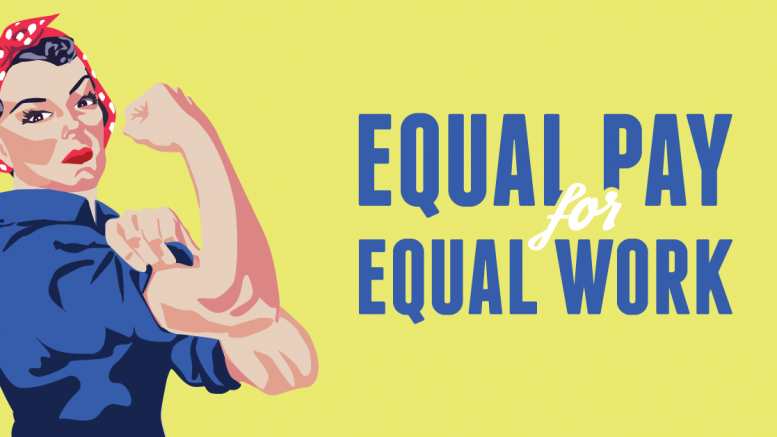
Image result for equal pay

After doing some research on gender inequality within the art world, I came across something rather disturbing that truly made my blood boil. 

Statistics show that women in the art industry are more likely to have a lower annual income compared to a male working in the industry. According to the article The status of women in the Canadian arts and cultural industries published in August 2018, on average in 2014, female visual artists earned 65% of what male visual artists earned. Salaries vary depending on what field you are working in, but for the majority, women tend to be paid thousands of dollars less per year in art fields than men, even if their job description is the same. 

May I express how F****D up this is? 

I feel like now more than ever our society has been advocating gender equality and women rights and pushing the boundaries of what used to be acceptable. This has given women the platform to be involved in various art fields and to have opportunities to succeed just as a man would. This is great because for centuries males have dominated the art industry and now the tables are turning, but the fact female artists do not get paid equally to male artists in 2019 is astonishing. It makes me feel that our society takes one step forward but then takes ten steps back. 

I wonder who makes the rules and decides women do not deserve the same wage or salary as a men do? If a female has a strong academic and creative background that has given her expertise and knowledge that makes her qualified for a position and a male meets the same standards, why is it that he gets favoured and paid more for the same quality of work? 

In all honesty, this form of discrimination makes me worried. I am a twenty one year old female who just applied to University to obtain a bachelors degree of fine arts with a major in design and I have a long journey ahead of me. The reason I chose this career path is because I have a creative mind that thinks outside of the box and I have proved to myself that I have the capabilities and the expertise to flourish in this field. After conducting my research and reading multiple articles and scholarly papers, I decided that this blog post should bring further awareness to gender income gaps in the art industry and to inform young adults who are in similar shoes as myself. Many people have written about this issue but I don’t think I’ve ever seen it from the perspective of a female art student. Is all the money, time and effort I am putting into my education worth it? Or am I setting myself up for struggle and failure? Looking at statistics from 2010 until present, I haven’t seen much of an improvement in gender income gaps. My question for my audience is how do you think we can fix a problem such as this and do you see it being fixed in the near future or do we have many obstacles before it is truly solved? 

Until next time…

Caitlin W.